Cloud Engineer Career Path: From Helpdesk to Azure Architect · CloudEngineerHub
Career13 min read5 views
Cloud Engineer Career Path: From Helpdesk to Azure Architect
A stage-by-stage roadmap from helpdesk to Azure architect: skills per stage, certifications in order, lab strategy, PowerShell fluency, and the moves that shorten the path.
C
CloudEngineerHub Team
Published: July 29, 2026· Last Updated: September 24, 2026·13 min read
Cloud Engineer Career Path: From Helpdesk to Azure Architect
Every Azure architect you admire was once resetting passwords on a helpdesk. The distance between those two jobs is not talent — it is a sequence of skills, proofs, and visible work, executed consistently for three to five years. The sequence is knowable, and most people fail it for avoidable reasons: certification hoarding, no lab, invisible work.
Visual Walkthrough
The compounding skill ladder every roadmap article on this site follows.
TimelineEndpoint Career Ladder — Helpdesk to Architect5/5
stage 1
1
Stage 1 · Helpdesk
Tickets teach empathy + Windows internals faster than books.
Design + mentorship; automation & guardrails by default.
stage 4
4
Stage 4 · Cloud/platform
Identity, CA, Azure fundamentals join the toolkit.
stage 5
5
Stage 5 · Architect
Strategy, governance, cost and security as one discipline.
Endpoint Career Ladder — Helpdesk to Architect. 1. Stage 1 · Helpdesk: Tickets teach empathy + Windows internals faster than books. — 2. Stage 2 · Endpoint admin: Intune/SCCM ownership; scripts replace repetitive fixes. — 3. Stage 3 · Senior engineer: Design + mentorship; automation & guardrails by default. — 4. Stage 4 · Cloud/platform: Identity, CA, Azure fundamentals join the toolkit. — 5. Stage 5 · Architect: Strategy, governance, cost and security as one discipline.
C
CloudEngineerHub Team
Author
The CloudEngineerHub editorial team — Microsoft endpoint management and cloud engineers writing hands-on guides on Intune, Azure, Entra ID, Autopilot, Defender and PowerShell. Every article is reviewed against current Microsoft documentation.
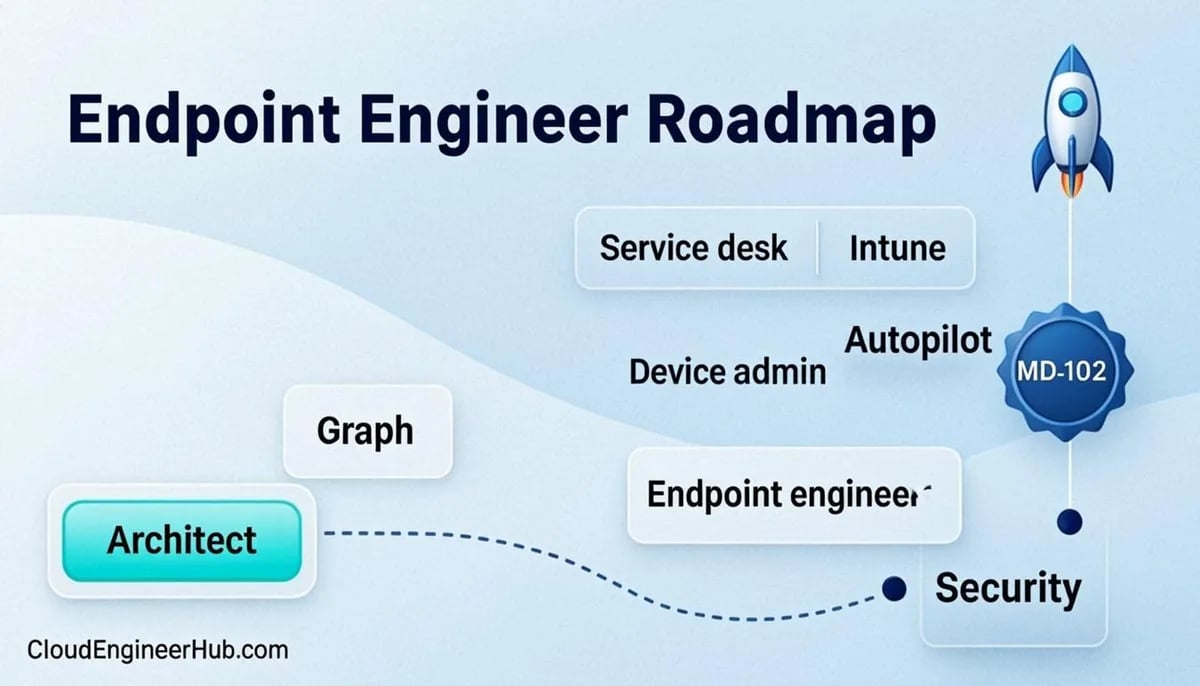
This guide lays out the full path in five stages, with the skills, certifications, and portfolio moves for each, plus the mistakes that stall careers at every level.
Overview
The helpdesk-to-architect path has two interleaved tracks. The platform track is depth: identity, endpoints, then Azure core (compute, networking, storage), then architecture. The governance track is breadth: security, cost, operations, and the stakeholder skills to argue for designs in business language. Helpdesk and endpoint roles are platform-track heavy; senior and architect roles are governance-track heavy.
Two structural truths shape the roadmap. First, each stage's output is the next stage's entry ticket: a helpdesk ticket queue is evidence for an endpoint admin role; an Intune implementation is evidence for cloud admin; a landing-zone migration is evidence for architect. Second, certifications open interviews; demonstrated work closes them — every stage below pairs the cert with the project that makes it real.
Prerequisites
A current IT foothold: helpdesk, service desk, NOC, or desktop support. If you are outside IT entirely, this path still works — just expect stage 0 to take longer.
Study bandwidth: 5–8 focused hours per week. Less than that and certifications take long enough to lose momentum.
A lab you control: a free Microsoft Entra tenant, an Azure subscription, and a home Windows 11 machine for Intune enrollment tests. Cloud skills without a lab do not survive interviews.
PowerShell: non-negotiable from stage 1 onward. It is the lingua franca of every role on this path.
Cost discipline: budget caps and cost alerts in your personal subscription from day one.
Step-by-Step Implementation
Stage 0: Helpdesk and Service Desk (Months 0–12)
Goal: become the person who fixes the recurring tickets, not the person who closes them fastest. Learn AD, MFA, printers-against-will, and the basics of Intune and Exchange Online from the tickets themselves. Take AZ-900 to frame everything in Azure vocabulary. Start a log of problems you solved and how — interview gold and the seed of your documentation habit. Ask for shadowing rotations with the Intune, identity, or infrastructure team; visibility is half the promotion.
Stage 1: Endpoint and Identity Administrator (Months 12–30)
Goal: own device and identity operations. Study for MD-102 (Intune, Autopilot, compliance, updates) and pick up SC-300 if your org is Entra-heavy. Build in the lab: full Autopilot deployment, compliance policies with Conditional Access integration, and scripted user lifecycle with Microsoft Graph PowerShell. At work, volunteer for the Intune migration or the Conditional Access rollout. Automate three of your own recurring tickets with PowerShell and tell your manager — that story is your stage-2 interview.
Stage 2: Azure Administrator (Months 30–48)
Goal: fluent in the Azure core. AZ-104 is the centerpiece cert; treat its domains (identity, governance, storage, compute, networking, monitoring) as your curriculum. Build a mini landing zone at home: hub-spoke vNet with peering, NSGs, a storage account with private endpoints, a VM with backup, Azure Monitor alerts — everything deployed twice: once by hand, once as Bicep or Terraform. At work, attach yourself to anything that touches subscriptions, policies, or cost. Learn to read a month-old Azure invoice and explain its top five line items; that skill alone differentiates you.
Stage 3: Senior Cloud Engineer (Months 48–66)
Goal: multiply through others. Define tagging and naming standards, write Azure Policy initiatives, build the golden-image pipeline, lead an AVD rollout, or run the cost-optimization program. Start AZ-305 preparation (design-focused: governance, identity, data, networking, business continuity) once you have real AZ-104-level scars to hang the design knowledge on. Presentation skills count now — write internal decision records, run lunch-and-learns, publish a polished runbook.
Stage 4: Azure Architect (Months 66+)
Goal: design authority. Architects choose between options with stakeholders in the room, defend the trade-offs, and leave designs that survive their departure. Close out AZ-305, and go deep on the Microsoft Azure Well-Architected Framework and the Cloud Adoption Framework. Your evidence: a set of designs you own end to end (landing zone, identity architecture, DR strategy, cost model), plus the arguments you won and lost and what you learned from each. At this stage, your network and reputation do more than any additional certification.
Configuration Deep Dive
The lab is the hidden curriculum. Keep it small and versioned: a Bicep/Terraform repo that stands up your landing zone on demand teaches more than months of portal clicking — and the repo is portfolio. Guardrails matter even solo — Azure Policy for allowed regions and VM SKUs, cost alerts at 50/80/100% of budget — because architects who never practiced governance build snowflakes professionally.
Certification sequencing beats certification count: AZ-900 → MD-102 and/or AZ-104 → AZ-305 is the spine; SC-300 or AZ-500 are lateral specials for identity or security tracks. Two warnings: do not book AZ-305 before real AZ-104-grade operational experience (the exam punishes it), and do not stack three certs in a year with no work artifacts — hiring managers read that as exam tourism.
Documentation is the multiplier. Write up everything: the Autopilot fix, the peering decision, the cost save. A public blog, a GitHub README, or an internal wiki page — the medium matters less than the habit. Every stage transition in this roadmap is powered by an artifact someone can read in five minutes.
Real-World Enterprise Scenario
A realistic composite: Priya starts on a 4,000-user service desk, spends month 6–12 automating password and license requests with Graph PowerShell (ticket volume down 18%), and uses that work to move into the endpoint team at month 14. She leads the tenant's Autopilot migration in year two, presents it internally, and is promoted to cloud administrator at month 30 — her AZ-104 was scheduled around the migration, not instead of it.
Year three she owns the subscription-governance cleanup: Azure Policy initiatives, tagging enforcement, and a cost report that finds 22% waste in idle dev VMs. At month 52 she is senior engineer; at month 61 she co-designs the new landing zone with a partner consultancy and takes the design lead on identity and DR. She passes AZ-305 at month 58 — by then the exam reads like a review of her year — and steps into the architect role at month 66. Total elapsed: five and a half years, one certification per chapter of work, and an artifact trail that made every interview short.
PowerShell for Career Planning
Track the roadmap like you would track infrastructure — as code with status output:
Pair every cert with one visible project in the same quarter
Skipping the lab
Cloud knowledge without hands-on decays in weeks
Maintain a versioned lab repo; rebuild it from scratch twice a year
Staying invisible on good work
Promotions are decided by people who saw the work
Demo monthly, write runbooks, volunteer for cross-team projects
Chasing every new service
Depth beats buzzword breadth until the architect stage
Master the core five: identity, networking, compute, storage, monitoring
Ignoring cost and governance
Architects who ignore cost lose credibility first
Run budget alerts on your own subscription from day one
Job-hopping before shipping
A pattern of unfinished migrations reads as risk
Stay through at least one complete project cycle per role
Visual Walkthrough
Each layer multiplies the ones below — never skip foundations.
Layered StackThe Engineer's Skill Stack5/5
PerimeterCore asset
1
OS internals
Registry, services, event logs, boot flow — the bedrock.
foundation
2
Networking + identity
DNS, TLS, Kerberos, Entra mechanics explain most mysteries.
layer 2
3
Automation
PowerShell + Graph turn hours into seconds — and into guardrails.
layer 3
4
Cloud platform
Azure/Intune services as building blocks, not black boxes.
layer 4
5
Architecture + security
Trade-offs, governance and Zero Trust tie it into strategy.
summit
Each layer assumes the previous one failed — depth is the strategy.
The Engineer's Skill Stack. 1. OS internals: Registry, services, event logs, boot flow — the bedrock. — 2. Networking + identity: DNS, TLS, Kerberos, Entra mechanics explain most mysteries. — 3. Automation: PowerShell + Graph turn hours into seconds — and into guardrails. — 4. Cloud platform: Azure/Intune services as building blocks, not black boxes. — 5. Architecture + security: Trade-offs, governance and Zero Trust tie it into strategy.
Common Errors
Error
Meaning
Resolution
Booking AZ-305 immediately after AZ-104 with zero design work
Design exams expect trade-off judgment, not recall
Do 12+ months of operational work first, then schedule
Treating AZ-900 as the destination
Fundamentals certificates open doors but do not define roles
Move to MD-102 or AZ-104 within two quarters
Learning only from video courses
Passive study creates the illusion of competence
Make every module produce a lab artifact
Keeping the plan in your head
Untracked plans drift; drift becomes stall
Keep the roadmap script (or a doc) and review it quarterly
Applying to architect roles with admin evidence
Titles follow artifacts, not applications
Target the next stage's title; collect its evidence first
Best Practices
One certification per chapter of real work — the cert certifies what you just did.
Automate your current job before trying to escape it; automation stories are transfer-proof.
Maintain the lab as code; your repo is your second resume.
Build the governance track deliberately: cost, policy, security, documentation.
Present internally every quarter — speaking is an architect skill, not a bonus.
Find a mentor one stage ahead; copy their artifact habits, not their job title.
Security Considerations
Security fluency is a career accelerant at every stage: helpdesk (identity hygiene), endpoint (compliance and encryption), admin (least-privilege RBAC and policy), architect (Zero Trust design). Practice what you preach in your own lab — MFA everywhere, no standing admin, secrets in Key Vault, not scripts. Hiring panels read a candidate's personal security habits as a preview of their professional ones.
FAQ
How long does the path really take?
Three years for strong candidates with supportive employers; five is typical. Stage transitions matter more than speed.
Do certifications matter, or only experience?
Both, in order of gatekeeping: certifications get the interview, artifacts close it. A cert with no project is a bookmark, not a credential.
Is the helpdesk actually required?
No — but the triage instincts and user-facing patience it builds explain why so many architects came from it. Any IT entry point works.
Should I specialize in security or stay general?
General through AZ-104, then specialize where your market pays: identity (SC-300), security (AZ-500), or architecture (AZ-305). Specialists become architects through the governance track.
What single skill accelerates the path most?
PowerShell with Graph and Az. Every stage of this roadmap runs faster for people who can script the boring parts.
Conclusion
The road from helpdesk to Azure architect is a five-stage loop of learn, build, prove, promote — run three to five times. Certifications mark the chapters, labs and artifacts prove the skills, and the governance track converts a strong administrator into someone trusted with design authority. Start stage 0 tonight: reset a password brilliantly, log it, book AZ-900, and put the roadmap in writing.


Comments
0No comments yet — be the first to share your thoughts.